Posted 5 January 2026
Molecular Imaging Research Centre Stakeholder Meeting: Clinical Engagement
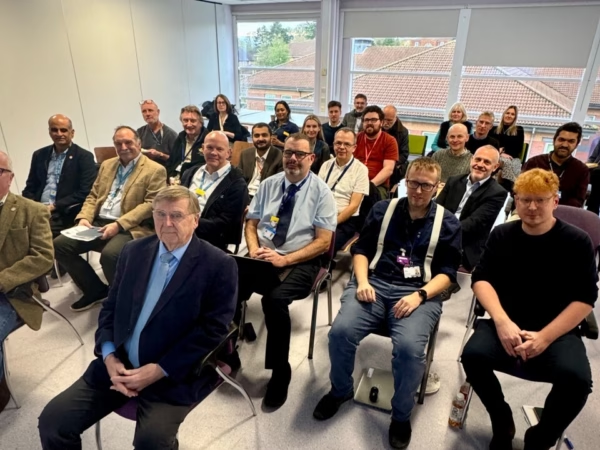
The Daisy Appeal brought together key stakeholders from Hull and East Yorkshire NHS Trust for a vital engagement meeting at the Daisy Appeal Building.
“We’re now at the starting blocks,” said Professor Nick Stafford, Chair of the Daisy Appeal.
The Daisy Appeal brought together key stakeholders from Hull and East Yorkshire NHS Trust for a vital engagement meeting at the Daisy Appeal Building. This gathering focused on recent updates, and clinical and research opportunities within the Molecular Imaging Research Centre (MIRC), highlighting the charity's ongoing fundraising efforts for a new digital PET-CT scanner. The event featured insights from leading experts, emphasising how these advancements will transform cancer, heart disease, and dementia diagnostics in the region.
Attendees included a diverse group of consultants and professionals from cardiology, oncology, radiology, infectious diseases, respiratory medicine, radiochemistry, radiation physics, and biology.
Speakers on the day:
- David Haire, Trustee, Daisy Appeal
- Professor Nick Stafford, Chair of the Daisy Appeal
- Dr Louis Allott, Radiochemistry Consultant and Director of Radiochemistry (Fractional) for the MIRC
- Glenn Woolley, Principal Clinical Scientist and Lead Physicist at Hull University Teaching Hospitals NHS Trust
- Dr. Saleem Azeem, Clinical and External Engagement Director, MIRC.
The talks were followed by an interactive brainstorming session where participants identified unmet clinical and research needs in Hull and across the UK where Positron Emission Tomography (PET) molecular imaging would be an invaluable tool.
“We’re now at the starting blocks,” Professor Stafford reiterated, underscoring the momentum toward groundbreaking healthcare improvements.
Advancing from Analogue to Digital Scanning
For the past decade, the Daisy Appeal has funded analogue PET scanning equipment at the Jack Brignall PET-CT Centre, which opened in 2014 at Castle Hill Hospital. Initially handling 1,500 scans annually, mainly for cancer, the Siemens PET scanner now supports 5,000 scans in 2025 alone. With a consistent 10% yearly increase and projections reaching 9,000 scans per year in the coming decade - including expanded dementia and cardiac imaging - the current setup cannot sustain future demand. The charity is therefore procuring multi-capability digital scanning equipment to move into the digital era of PET imaging.
What Does PET Scanner Advancement Provide?
- Lower radiation dose, making scans safer for young adults, children, routine screenings, and potentially pregnant women.
- Reduced scan times for greater patient comfort, increased scanning capacity, and faster throughput.
- Improved image quality with higher contrast, better resolution, and less noise.
- Increased sensitivity to detect smaller and earlier disease signals more reliably.
- Enhanced temporal resolution to capture motion-free, more accurate images, allowing better assessment of tissues that move during scanning, such as the heart and lungs.
- Scalability to meet future increases in demand.
Daisy’s Current Target: £3 Million
The Charity has already raised approximately £1.3m towards the £3 million target and the selected GE Healthcare OMNI model is on order. This modular upgrade will nearly double annual scan capacity and enable screening for conditions such as lung cancer, repeated scans for individual patients, and safer imaging for children and potentially pregnant women - reducing radiation exposure and scan times. It also opens new research avenues in paediatric trials, young adult conditions such as Crohn’s disease and juvenile arthritis, and studies involving patients unable to remain still during long scans. Future funding could add a second "doughnut" module, potentially making it one of the limited number of total-body scanners in the UK , alongside those in London and Edinburgh.
On-Site Innovation and Research Opportunities
The Daisy Appeal’s MIRC, commissioned in 2024, already features a full-scale medical cyclotron operational since early 2022, producing PET radiotracers on-site and eliminating reliance on external sources. Among the first in-house radiopharmaceuticals to be produced for clinical use at MIRC will be Gallium-68 DOTATOC for neuroendocrine tumours (NETs) and the Gallium-68 PSMA agent for prostate cancer imaging via PSMA PET scans. These will target thousands of patients in Yorkshire and the North of England who currently lack access to Gallium-68 scans. Previously, such advanced scans for clinical or research purposes required travel to London or other UK centres. The introduction of PSMA imaging is predicted to significantly increase scanning demand, further emphasising the need for a new scanner.
Lead Research Studies
The meeting also offered clinical stakeholders a direct opportunity to lead research studies. Dr Azeem shared that he is exploring the option of a potential pump-priming grant in discussion with the charity. If approved, this would provide six free scans to three local clinical or academic investigators, helping to generate pilot data that supports larger grant applications and enhances the unit’s research output and reputation. This pump-priming approach will accelerate trials, including potential collaborations with other UK centres. As Dr Louis Allott observed, “Everyone here wants to see a push from clinical trials to routine use,” positioning the region as a hub for cancer imaging research and care.
Over the past 24 years, the Daisy Appeal has invested more than £20 million in medical research facilities, ensuring continued progress and relevance amid rapidly evolving technology.
This stakeholder engagement reinforces the charity's commitment to innovation and collaboration.
Click for more information on how to get involved